
Global buyers are paying closer attention to tubing cleanliness, safety, and lifecycle performance. Odorless Silicone Tube is increasingly considered for medical devices, food-processing equipment, laboratory systems, and fluid-transfer applications. Its low odor can improve user confidence near sensitive products. It also supports cleaner working environments.
Grand View Research reported that the global silicone market reached billions of dollars in recent years, with continued growth expected through 2030. MarketsandMarkets also identifies healthcare, food, and industrial processing as important silicone application sectors. These trends suggest stronger demand for traceable, high-performance tubing. However, market growth does not automatically prove product quality. Specifications still matter.
A reliable purchasing review should examine platinum-cured or peroxide-cured construction, hardness, tensile strength, temperature range, and compression resistance. For food contact, buyers should request applicable FDA or EU compliance documentation. Medical projects require stronger evidence, including ISO 10993 evaluation when relevant. ISO 13485-certified manufacturing can also indicate better quality control, although certification alone is not a complete guarantee.
Look closely at the tube surface. It should appear smooth, uniform, and free from bubbles, cracks, or sticky residue. Ask for batch records, migration testing, odor evaluations, and sample approval procedures. A faint smell may come from packaging, curing, or storage rather than the silicone itself. That detail is easy to overlook.
Real-world selection remains imperfect. A tube that performs well in a laboratory may behave differently after repeated sterilization or long-term compression. Global buyers should compare test data with actual operating conditions. This 2026 guide examines material quality, compliance, customization, supplier reliability, and total cost before purchase.
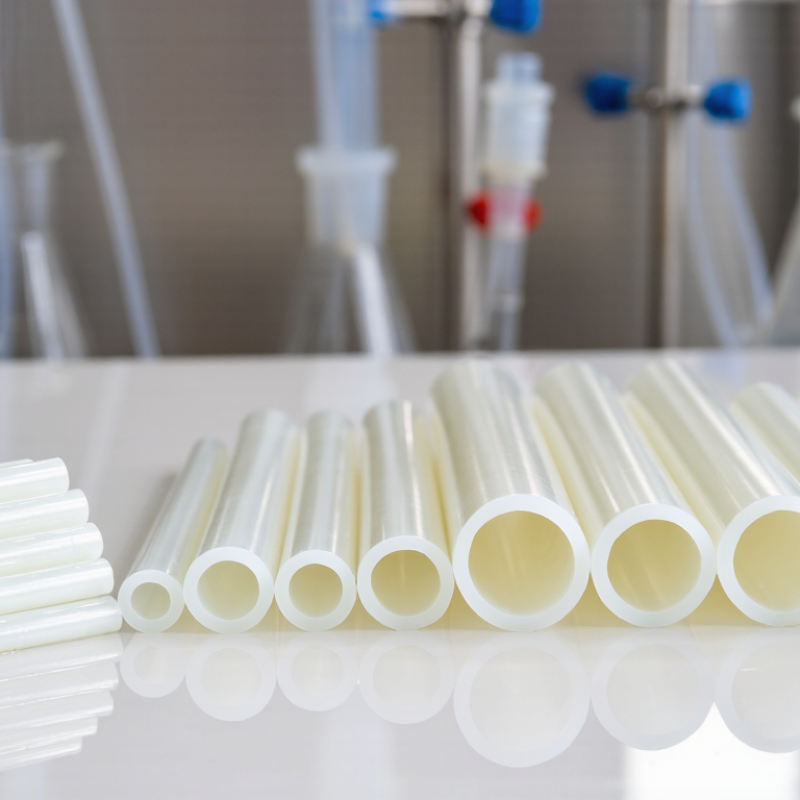
For global buyers, an odorless silicone tube should begin with VMQ, not marketing language.
VMQ offers stable flexibility, weather resistance, and low odor after proper post-curing. Grand View Research’s 2024 silicone market assessment identifies healthcare and food-contact uses as important growth areas. These sectors demand controlled formulation and documented testing.
Shore A 20–80 covers very different performance needs.
Shore A 20 feels soft and bends around tight fittings. Shore A 80 resists compression and external pressure better.
ASTM D2240 should verify hardness, preferably on finished tubing.
Test records should include temperature, sample thickness, and conditioning time.
Small details matter.
Cure type also changes selection.
Peroxide-cured VMQ may require post-curing to reduce volatile residues and residual smell. Platinum-cured silicone is often preferred when cleanliness, low extractables, and neutral odor are critical.
ISO 10993 testing can support medical-contact evaluations, but it does not automatically prove odorlessness. Ask for batch-specific odor, extractables, and post-cure records.
A perfect tube does not exist.
I would question any supplier offering only a hardness number.
Surface tack, inner-wall cleanliness, compression set, and storage conditions still need review.

An odorless silicone tube should be judged by measured emissions, not by a quick warehouse smell test. ASTM E595 provides useful outgassing data for vacuum-sensitive applications. Laboratories typically report total mass loss and collected condensable materials under controlled heat and vacuum. These figures help buyers compare curing quality and volatile residues. However, ASTM E595 does not prove that a tube has no odor in a room.
ISO 16000 testing addresses indoor-air emissions more directly. A laboratory can place a conditioned tube sample inside a controlled chamber, then analyze released VOCs. Thermal desorption and GC/MS methods can identify compounds at low concentrations. Ask for sampling temperature, exposure time, sample surface area, curing age, and detection limits. Without these details, a low VOC number may look impressive but remain difficult to verify.
Real-world checks still matter. Open a sealed tube after transport, warm it moderately, and record odor changes over several hours. Compare results from different production lots. A strong smell may appear after packaging, even when initial factory data looks clean.
One limitation remains. Odor perception varies between people and regions. Therefore, reliable suppliers should combine ASTM E595 results, ISO 16000 VOC data, and documented sensory evaluations.
“Odorless” should mean odor below a defined test threshold, not an absolute promise.
2026 Best Odorless Silicone Tube for Global Buyers
An odorless silicone tube should offer more than a clean first impression. Safety documentation matters. For food-contact applications, FDA 21 CFR 177.2600 addresses extractable substances from repeated-use rubber articles. A suitable tube requires controlled raw materials, proper curing, and relevant testing. A supplier’s declaration should identify the formulation and intended use. Generic claims are not enough.
USP Class VI evaluates biological reactivity under defined test conditions. It can support medical and pharmaceutical applications, but it does not replace application-specific risk assessment. ISO 10993 is broader. It guides biological evaluation according to contact type, duration, and patient exposure. A tube touching skin briefly needs different evidence from one carrying fluids during extended contact. The distinction is easy to miss.
Check lot traceability, tensile strength, hardness, and dimensional stability. Also review extractables, leachables, sterilization resistance, and temperature limits. Odorless is not proof of purity. I have found that a tube can smell neutral yet lack complete compliance records. That should trigger questions. Ask for current test reports, not old marketing sheets. Confirm whether testing covers the actual color, size, curing method, and production lot. Documentation may still be incomplete. That is a practical weakness worth correcting before international shipment, especially when buyers face different regulatory expectations across markets.
| Tube Configuration | Typical Inner Diameter | Typical Wall Thickness | Typical Hardness | Operating Temperature Range | Appearance and Odor | Typical Application | FDA 21 CFR 177.2600 | USP Class VI | ISO 10993 | Recommended Buyer Documentation |
|---|---|---|---|---|---|---|---|---|---|---|
| Flexible general-purpose tube | 1.0–6.0 mm | 1.0–2.0 mm | 50–60 Shore A | Approximately −60 to 200°C | Translucent or clear; low-odor platinum-cured silicone | Fluid transfer, laboratory lines, dispensing equipment, and low-pressure pneumatic connections | Suitable when formulation and use conditions comply | Confirm lot-specific test report | Confirm biological evaluation scope | Food-contact declaration, formulation statement, extractables information, and batch traceability |
| Thin-wall precision tube | 0.5–3.0 mm | 0.5–1.0 mm | 50–70 Shore A | Approximately −60 to 180°C | Clear or translucent; low odor after post-curing | Peristaltic pumps, analytical instruments, dosing systems, and compact fluid paths | Applicable only to qualifying food-contact formulations | Verify USP Class VI test method and report | Not automatically medical-device compliant | Dimensional inspection record, curing process information, USP test report, and change-control statement |
| High-flexibility pump tube | 2.0–12.0 mm | 1.5–3.0 mm | 40–55 Shore A | Approximately −50 to 180°C | Translucent; low odor; optimized for repeated flexing | Peristaltic pumping, beverage dosing, laboratory pumping, and flexible connections | Use only with documented food-contact compliance | Confirm suitability for repeated compression | Assess mechanical and biological requirements separately | Fatigue-life data, bore-collapse data, extractables profile, and cleaning compatibility statement |
| Reinforced pressure tube | 3.0–25.0 mm | 2.0–5.0 mm plus reinforcement | 60–80 Shore A | Approximately −50 to 180°C | Translucent outer silicone with textile reinforcement; low odor | Higher-pressure transfer, filling equipment, washdown systems, and industrial fluid handling | Check whether reinforcement materials are covered | Whole-tube construction must be evaluated | Evaluate all patient-contacting and extractable materials | Pressure and burst data, reinforcement material declaration, sterilization compatibility, and compliance reports |
| High-temperature tube | 2.0–20.0 mm | 1.5–4.0 mm | 50–70 Shore A | Approximately −60 to 220°C, application dependent | Clear or translucent; low odor after controlled post-curing | Hot-air lines, thermal processing equipment, laboratory heating systems, and high-temperature fluid transfer | Food-contact limits depend on time, temperature, and medium | Confirm thermal aging and extractables data | Sterilization and aging effects require evaluation | Thermal aging report, maximum-use-temperature statement, extractables data, and cleaning validation information |
| Medical and bioprocess tube | 1.0–25.0 mm | 1.0–4.0 mm | 45–70 Shore A | Approximately −50 to 200°C, depending on design | High-clarity or translucent; platinum-cured and low odor | Single-use assemblies, laboratory bioprocessing, pharmaceutical transfer, and medical fluid pathways | FDA food-contact status does not equal medical approval | Specify USP Class VI test evidence where required | Define applicable ISO 10993 endpoints for the intended contact | Biocompatibility evaluation, sterilization validation, extractables and leachables data, and material-change notification |
For global buyers, an odorless silicone tube should be judged by measured performance, not appearance. Many technical datasheet surveys report service ranges near −60 to 200°C for high-quality silicone elastomers. However, the range depends on formulation, curing, wall thickness, and exposure time. Some tubes develop compression set after prolonged heat. That detail is easy to overlook.
Tensile results should follow ASTM D412 or ISO 37:2017.
Common silicone tubing data shows tensile strength around 6–10 MPa, with elongation often between 300% and 700%. These figures are useful benchmarks, not universal promises. A tube may stretch well but still perform poorly under repeated pressure pulses. I would request batch test results, especially when the tube carries warm air, water, or process fluids.
Pressure capability cannot be selected from temperature data alone. Engineers must check inside diameter, wall thickness, hardness, reinforcement, and duty cycle. A thin tube may tolerate −60°C yet fail after bending at 200°C. ISO 1817 testing can help assess volume change after fluid exposure.
Odor control also needs evidence, such as post-curing records and extractables testing. “Odorless” is not always chemically identical to “zero emission.” That distinction matters.
A practical purchasing file should include tensile strength, elongation, hardness, pressure testing temperature, and failure observations. The final weakness is often documentation, not silicone.
A buyer matrix should begin with measurable odor, not vague “odorless” claims. VDA 270 uses a six-level odor intensity scale, so request the tested grade and conditioning method. Grand View Research estimated the global silicone market at USD 18.5 billion in 2023, with a projected 7.8% annual growth through 2030. That growth increases supplier choices, but not necessarily consistency.
For tolerances, specify inner diameter, wall thickness, ovality, and length separately. ISO 3302-1 provides dimensional tolerance classes for rubber products. Ask suppliers to state the selected class. A lot number should connect raw material, cure date, operator, test results, and packaging record. Traceability sounds simple. It often fails after repacking.
MOQ can hide the real cost. A 500-meter minimum may reduce unit price, but creates storage risk. Request sample pricing, production MOQ, and annual volume breaks. Compare cost per meter using tube price, tooling, inspection, packaging, freight, duty, and insurance. For Incoterms, EXW may look cheapest while transferring export work early. FOB, CIF, and DAP produce different landed costs. Compare one destination and one shipment size. A practical matrix might show USD 1.20 per meter at the factory, but USD 1.86 delivered. That gap matters. Some quotations still omit testing fees, and buyers should challenge that omission.

| Sunday | CLOSED | |
| Monday | 9AM-12PM | 1PM-6PM |
| Tuesday | 9AM-12PM | 1PM-6PM |
| Wednesday | 9AM-12PM | 1PM-6PM |
| Thursday | CLOSED | |
| Friday | 9AM-12PM | 1PM-6PM |
| Saturday | 10AM-12PM | 1PM-6PM |
Please note that we are closed for lunch from 12PM-1PM daily.