
How to Choose an Electric Bicycle Scooter Supplier?
Choosing an Electric Bicycle Scooter supplier is not simply a price comparison. It is a decision about product safety, battery reliability, compliance, and long-term customer support.
Industry data shows why this decision deserves care. The Confederation of the European Bicycle Industry reported that Europe sold about 5.1 million electric bicycles in 2022. Germany’s Zweirad-Industrie-Verband recorded approximately 2.1 million e-bike sales in 2023. These figures show strong demand, but they also expose buyers to uneven manufacturing quality. Market forecasts from firms such as Grand View Research and Mordor Intelligence also indicate continued growth in electric two-wheelers. Forecasts differ, however. Definitions, regions, and product categories are not always consistent.
A reliable supplier should provide traceable battery cells, documented testing, clear warranty terms, and stable spare-parts access. Ask for certificates that match the destination market, including relevant electrical, battery, and electromagnetic requirements. Do not accept a logo or a copied test report as proof. Request the original document and verify its scope. A factory audit can reveal practical details: organized battery storage, torque-controlled assembly tools, and labeled quality checkpoints. Small details matter.
Real experience also means testing the vehicle before placing a large order. Check braking distance, folding joints, charger temperature, tire wear, and controller response. Suppliers should explain failure rates honestly, not only display polished showroom samples. Some buyers focus too heavily on the lowest quotation. That can become an expensive mistake.
A careful sourcing process compares engineering evidence, production consistency, communication speed, and after-sales capability. The best supplier may not offer the cheapest unit. It should offer dependable performance, transparent documentation, and a realistic path for resolving problems.
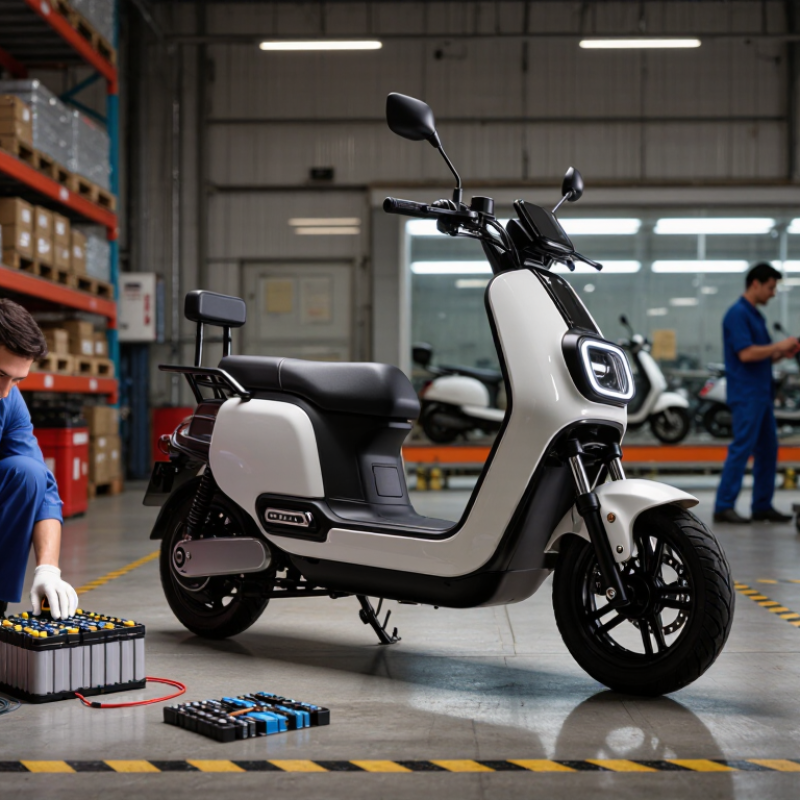
Define Requirements: 250–750 W Motors, 36–48 V Batteries, and 25 km/h Limits
Choosing an electric bicycle scooter supplier starts with a precise power and speed brief. Specify a 250–750 W motor range, while separating rated power from temporary peak output. A supplier should state both figures clearly. The battery should use a 36–48 V system, with capacity shown in ampere-hours and watt-hours. For example, a 48 V, 10 Ah pack stores about 480 Wh before operating losses. The International Energy Agency’s Global EV Outlook 2024 identifies electric two- and three-wheelers as the largest electrified road-transport segment by sales. That scale makes battery traceability and testing increasingly important.
Ask suppliers to demonstrate a genuine 25 km/h limit under load, not only on a repair stand. Request controller settings, speedometer accuracy data, battery-management-system specifications, and thermal test records. EN 15194 testing practices can help assess electrically assisted cycles in applicable markets, but local rules still decide classification and compliance. A careful supplier will provide model-specific certificates, cell documentation, charging instructions, and batch records. Vague paperwork is a warning sign.
I would also inspect a production sample. Small details matter: connector sealing, brake cut-off response, cable routing, and charger temperature after two hours. The UL Solutions 2024 Global Safety Science Insights report emphasizes that connected and battery-powered products require stronger safety validation as adoption grows. Still, reports do not replace field checks. A spreadsheet can look perfect. Real hills may disagree. Avoid suppliers that promise maximum range without stating rider weight, terrain, temperature, and test conditions.
| Evaluation Dimension | Option 1 Urban Compact | Option 2 Commuter Standard | Option 3 Long-Range Commuter | Option 4 Utility Cargo | Option 5 Performance-Limited | Recommended Supplier Requirement |
|---|---|---|---|---|---|---|
| Rated Motor Power | 250 W | 350 W | 500 W | 750 W | 750 W | Accept only motors within the defined 250–750 W range; confirm whether the rating is nominal or peak power. |
| Battery Voltage | 36 V | 36 V | 48 V | 48 V | 48 V | Use 36–48 V systems and require the supplier to provide battery, charger, and controller compatibility details. |
| Battery Capacity | 7.8 Ah / 281 Wh | 10 Ah / 360 Wh | 12.5 Ah / 600 Wh | 15 Ah / 720 Wh | 10 Ah / 480 Wh | Request the rated watt-hours, cell configuration, cycle-life data, and protection-circuit specifications. |
| Maximum Assisted Speed | 25 km/h | 25 km/h | 25 km/h | 25 km/h | 25 km/h | Mandatory limit Verify the speed setting in the controller and confirm that it cannot be easily bypassed. |
| Estimated Practical Range | 25–40 km | 35–55 km | 50–75 km | 45–70 km | 35–55 km | Require test conditions, rider/load assumptions, terrain, assist level, and ambient temperature for every range claim. |
| Charging Time | 4–6 hours | 5–7 hours | 6–8 hours | 7–9 hours | 5–7 hours | Check charger output, input voltage, battery temperature limits, and automatic charge termination. |
| Maximum Permitted Payload | 100 kg | 120 kg | 120 kg | 150 kg | 120 kg | Payload must include rider, luggage, accessories, and cargo; request frame and fork load ratings. |
| Brake Configuration | Mechanical disc, 160 mm | Hydraulic disc, 160 mm | Hydraulic disc, 180 mm | Hydraulic disc, 180 mm | Hydraulic disc, 180 mm | Specify brake type, rotor diameter, pad material, parking function, and wet-weather stopping performance. |
| Tyre Size | 20 × 2.125 in | 26 × 1.95 in | 27.5 × 2.10 in | 20 × 3.00 in | 27.5 × 2.25 in | Confirm tyre availability, puncture-protection options, maximum inflation pressure, and replacement cost. |
| Ingress Protection Target | IP54 | IP54 | IP54 | IP54 | IP54 | Verify by test report IP ratings apply only to tested components and do not mean the vehicle is waterproof. |
| Frame Material | Aluminium alloy | Aluminium alloy | Aluminium alloy | Aluminium alloy with reinforced rear section | Aluminium alloy | Request alloy designation, weld inspection procedure, fatigue-test evidence, and corrosion-treatment details. |
| Safety and Compliance File | Technical file required | Technical file required | Technical file required | Technical file required | Technical file required | Request applicable-market conformity documents, risk assessment, EMC results, charger certification, and battery transport documentation. |
| Battery Protection Features | Overcharge, over-discharge, overcurrent | Overcharge, over-discharge, overcurrent | Overcharge, over-discharge, overcurrent, temperature monitoring | Overcharge, over-discharge, overcurrent, temperature monitoring | Overcharge, over-discharge, overcurrent, temperature monitoring | Require a documented battery-management-system specification and protection test results. |
| Sample Lead Time | 15–25 days | 20–30 days | 25–35 days | 30–45 days | 25–35 days | Lead time should include assembly, testing, packaging, and pre-shipment inspection. |
| Typical Production Lead Time | 35–50 days | 40–55 days | 45–60 days | 50–70 days | 45–60 days | Obtain a written schedule covering component procurement, production, quality inspection, and shipment readiness. |
| Suggested Quality-Control Checks | Brake, folding mechanism, battery output | Brake, motor output, display, charger | Battery endurance, motor temperature, braking | Frame load, wheel alignment, braking, battery endurance | Motor temperature, braking, controller speed limit | Use a signed inspection checklist with functional, electrical, mechanical, cosmetic, and packaging checks. |
| Best-Fit Application | Short urban trips and compact storage | Daily commuting on paved roads | Longer commutes and moderate inclines | Passenger or cargo transport with higher load demand | Hilly routes requiring stronger low-speed assistance | Choose the configuration according to terrain, payload, legal limits, serviceability, and total cost of ownership. |
All range, charging-time, payload, and lead-time figures are practical procurement benchmarks rather than guaranteed performance values. Final specifications should be confirmed through a signed technical datasheet, physical sample testing, and applicable market-compliance documentation.